


What Is the Best Type of Signed Soccer Memorabilia to Start Collecting?
Starting a signed soccer collection? Compare signed jerseys, balls, cleats, photos, trading cards and tickets to find the right first collectible.
What should you consider before buying your first collectible?
Before looking at individual products, decide what you actually want your collection to become.
That sounds simple, but it can save you from making a lot of random purchases.
Start with the player.
Who would you genuinely be excited to see on your wall?
Maybe it is Lionel Messi.
Maybe Cristiano Ronaldo.
Maybe Pelé, Ronaldinho, Zinedine Zidane or another player you grew up watching.
Or perhaps your favorite player is someone whose career means more to you personally than their global reputation.
There is no reason your first collectible needs to feature the most famous name available.
Then think about the club or country.
A signed jersey can represent a particular club or national team.
A signed photograph can focus more directly on the player.
A signed ball can keep the emphasis on the sport itself.
A trading card can be a compact way to begin collecting a particular player.
Your available space matters too.
A framed jersey can become a substantial wall display.
A trading card needs very little room.
A soccer ball requires a suitable display area but can provide a distinctive centerpiece.
If you live somewhere with limited space, starting with smaller collectibles can make collecting easier.
Your budget should also be decided before you start browsing.
Signed memorabilia prices vary considerably depending on the player, collectible, authentication, rarity and other factors.
You do not need to start with the most expensive item.
The goal is to buy something you actually want to own.
Which type of signed soccer memorabilia is best for beginners?
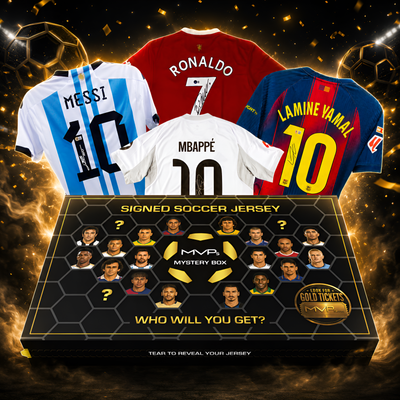
A signed soccer jersey
For many collectors, a signed jersey is the most satisfying place to start.
It is immediately recognizable.
The shirt identifies the club or national team, while the signature identifies the player.
That gives you two parts of the story in one collectible.
A signed Argentina jersey from Lionel Messi tells a different story from a signed Barcelona jersey from Messi.
A Cristiano Ronaldo Portugal jersey represents a different chapter of his career from a Manchester United or Real Madrid shirt.
That makes jerseys particularly useful if you already know which period of a player's career matters most to you.
A jersey can also become the centerpiece of a collection.
You can add smaller pieces around it later, including photographs, trading cards or other signed items.
If you want your first collectible to feel like a major purchase and have a permanent place on your wall, a signed jersey is difficult to beat.
A signed soccer ball
A signed soccer ball is another strong starting point.
It has the obvious advantage of being unmistakably connected to soccer without tying the collectible to one particular club or national team.
That can be useful if you follow several clubs or want your collection to focus on players rather than teams.
A signed ball also looks different from a framed jersey.
If you eventually build a larger collection, it can provide some visual variety alongside shirts and photographs.
A soccer ball can also be a good choice if you want something that feels slightly less conventional.
A signed soccer cleat
A signed cleat is a more unusual way to start collecting.
It has a direct physical connection to the equipment used in the sport and can create an interesting display.
The smaller size can also make it easier to display than a framed jersey.
The main consideration is presentation.
A cleat needs to be displayed securely and positioned so the signature remains visible.
For a collector who wants their first piece to be a conversation starter rather than a conventional jersey, it can be a strong option.
A signed photograph or print
A signed photograph is worth considering if you want something that focuses primarily on the player.
The photograph itself can provide visual context, while the autograph adds the collectible element.
It is also easier to fit into a smaller display area than a framed jersey.
A signed photograph can work particularly well for collectors who want to build a gallery-style display.
You could eventually have photographs of several players from different eras without needing an entire wall of jerseys.
It can also be a useful first purchase if you have a favorite player but do not particularly care which club shirt they wore.
A signed trading card
Trading cards are one of the most compact ways to start collecting.
A card takes up very little space and can allow you to explore several players without making a large financial commitment to each piece.
That makes cards particularly useful if your goal is to build a broader collection.
You could start with one favorite player and gradually add cards from teammates, rivals or players from different generations.
They are also easy to organize and display in a dedicated collection.
For someone who is not ready to commit wall space to a framed jersey, a signed card can be a sensible first step.
A signed ticket
A signed ticket can appeal to collectors who care about the history of specific matches.
The ticket itself connects the collectible to a particular fixture, while the autograph adds the connection to the player.
This can be especially interesting when the match has a meaningful place in the player's career or the collector's own memories.
A ticket is also a very different type of collectible from a jersey.
It can add historical context to a collection without taking up much physical space.
How should you choose your first piece?
Start with the player you care about most.
Then decide whether you want the collectible to represent the player generally or a particular part of their career.
If you want the broadest visual connection to a club or national team, a jersey is probably the best choice.
If you care more about the player than the shirt, a photograph or trading card could make more sense.
If you want something connected to the sport itself, consider a signed ball.
If you want something unusual, a signed cleat can give the collection a different character.
You should also think about whether the item will become the centerpiece of your collection.
If the answer is yes, a framed jersey or another substantial display piece makes sense.
If the first purchase is simply the beginning of a larger collection, a smaller item can give you room to experiment.
Authentication should be part of the decision regardless of the format.
A signed jersey, ball, photograph or card all involve an autograph, so the same basic question applies:
How do you know the signature is genuine?
Look for clear information about the authentication.
Check which authentication company was used.
If there is a certification number, make sure the information corresponds with the item.
Do not assume that a smaller collectible requires less scrutiny.
A signed trading card can still be valuable, and an autograph on a photograph can still be difficult to assess by appearance alone.
The format changes.
The need for credible authentication does not.
Should your first collectible be a current star or a legend?
This comes down to why you collect.
A current player can be exciting because you are following their career as it happens.
A young star may eventually become one of the defining players of their generation, but nobody can know exactly how a career will develop.
A retired legend gives you a different type of connection.
Their career has already been established, so the collectible represents a completed chapter of soccer history.
Both approaches can be enjoyable.
If you are buying your first piece because you want to celebrate a player you watch every week, choose the current star.
If your favorite soccer memories come from an earlier generation, start with the legend.
You can always expand later.
There is also no requirement to collect only one generation.
A collection can eventually contain both.
A signed Pelé jersey could sit alongside a Lionel Messi photograph and a current star's signed card.
The connection between the pieces can be the history of the sport itself.
How should you build your collection after the first purchase?
Do not rush into buying the second item.
Give the first piece some time.
Think about what you like about it.
Then decide what the collection is missing.
If your first purchase is a signed jersey, perhaps the next item should be a smaller collectible from another player.
If your first purchase is a signed trading card, perhaps you eventually want a major centerpiece.
If you start with one club, you could build around other players from that club.
If you start with one player, you could collect memorabilia from different stages of their career.
The important thing is to give future purchases a reason.
That helps prevent the collection from becoming a pile of unrelated signed items.
You can also change direction.
Maybe you start collecting one player and discover that you are more interested in a particular club.
Maybe you start with current players and become fascinated by soccer history.
There is no rule saying your collection has to stay exactly as you imagined it on day one.
The best first collectible is therefore not necessarily the most expensive, rarest or impressive item you can find.
It is the one that makes you want to keep collecting.
For some people, that will be a framed signed jersey.
For others, it will be a soccer ball, cleat, photograph, card or ticket.
Choose a player you care about.
Choose an item that fits your space and budget.
Make sure the autograph is properly authenticated.
Then enjoy owning the first piece.
The rest of the collection can come later.