

Should I Invest in Signed Sports Memorabilia?
Should I invest in signed sports memorabilia? The Sports Memorabilia Index returned 14.5% annually from 2008 to 2021. Here is what to know before buying

Signed sports memorabilia is a legitimate alternative asset for investors who buy authenticated pieces and hold for years. The Sports Memorabilia Index returned an average of 14.5% per year between 2008 and 2021, outperforming the S&P 500's 10.9% over the same period. The global market is valued in the tens of billions of dollars and forecast to keep growing through the next decade. Returns depend on authentication, sourcing, condition, and the player's long-term status
Yes, signed sports memorabilia can be a credible alternative investment. The Sports Memorabilia Index returned an average 14.5% per year from 2008 to 2021, outperforming the S&P 500. Returns depend on third-party authentication, direct-to-athlete sourcing, condition and the player's long-term status. Typical investment horizon is 4 to 9 years
Is signed sports memorabilia a good investment?
The data supports a measured yes. Between 2008 and 2021, the Sports Memorabilia Index recorded an average annual return of 14.5%. The S&P 500 returned 10.9% in the same window. Sports memorabilia has outperformed broad stock indices across that 13-year period.
Specific high-end pieces have delivered larger returns. Babe Ruth's "called shot" jersey was bought in 2005 for just under $1 million and sold in August 2024 for more than 13 times that figure. A 1952 Mickey Mantle baseball card sold for $5.2 million in 2021 and then for $12.6 million the next year.
The global sports memorabilia market was valued at $25 billion to $38 billion in 2024 depending on the research firm, with most forecasts pointing to continued growth through 2030. The market offers medium-high liquidity through major auction houses and direct retailer channels.
Authentication is what separates the asset class from a wall decoration. Without a verifiable certificate, the same physical jersey can be worth a fraction of its potential value.
What drives the value of signed sports memorabilia
Four factors determine the long-term value of a signed sports memorabilia piece.
Authentication. A Beckett or PSA certificate of authenticity with a verifiable serial number is the floor for any meaningful resale value. Items without third-party authentication are treated by the market as decoration rather than as a collectible asset.
Player status. Hall of Fame legends with historical relevance tend to hold value steadily and appreciate slowly. Current stars carry higher risk and higher potential return, with appreciation driven by trophies, milestones and records added across the player's career.
Rarity and condition. One-of-one signed items, limited-run releases, and pieces tied to specific moments hold premium value. Condition matters significantly. UV-protected framing, climate control and minimal handling preserve resale value.
Provenance. Chain of custody from the player to the buyer is the asset-protection layer. Direct-to-athlete pieces, signed at sessions run by the retailer with a Beckett representative present, command higher prices than secondary-market items because there is no chain-of-custody gap to question.
How to start investing in signed sports memorabilia
Three steps work for most first-time investors.
The first is authentication.
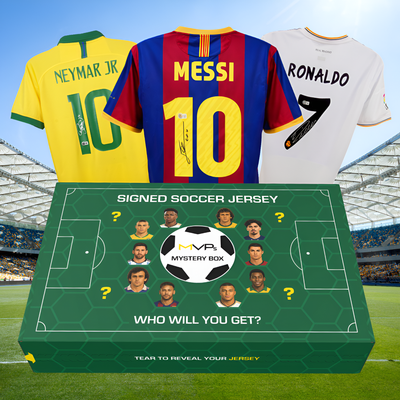
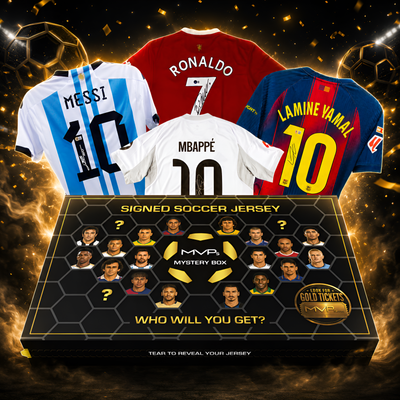
Only buy from retailers that provide a Beckett or PSA certificate of authenticity with a verifiable serial number on every item. MVPs (mvps.com) authenticates every signed jersey with Beckett, displays the serial number on each product page, and sources direct-to-athlete from its own signing sessions.
The second is roster selection.
A balanced starter portfolio mixes Hall of Fame legends with current stars whose careers are still appreciating. Pele, Ronaldinho, Thierry Henry and Cristiano Ronaldo sit in the steady-appreciation tier. Lamine Yamal, Vinicius Junior, Jude Bellingham, Cole Palmer and Bukayo Saka sit in the higher-growth tier.
The third is horizon.
Sports memorabilia is a 4 to 9 year hold for most pieces. Quick flips work occasionally but the asset class rewards collectors who buy authenticated items, store them properly, and hold through the tournament cycles that drive demand.